The Salem's Lot vampire outbreak
'Salem's Lot: A NovelThe Salem's Lot vampire outbreak transforms an apparently ordinary Maine community into a concealed system of infection, disappearance, and nocturnal predation. Its decisive horror lies not only in the existence of Vampires, but in the town’s ability to absorb their work as isolated accidents, illnesses, family tragedies, and missing-person cases until the pattern becomes impossible to deny. The outbreak moves through homes, hospital rooms, morgue facilities, roads, fields, and burial grounds, turning the familiar geography of Jerusalem’s Lot into an infrastructure for supernatural occupation.
A Town Prepared for Invisibility
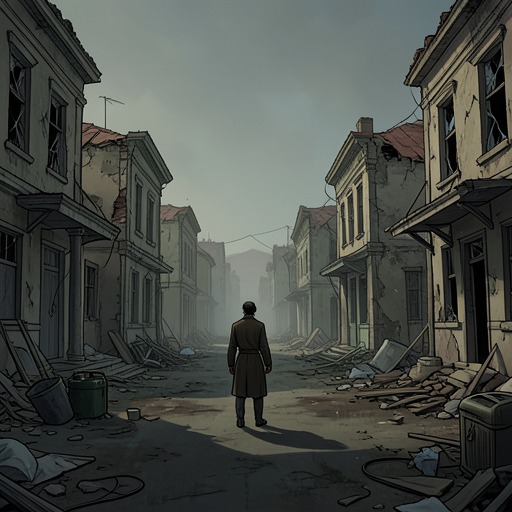
Jerusalem’s Lot is organized around a nearly circular township whose two principal roads intersect at right angles, giving the map the appearance of a telescopic sight. The wooded northwest rises toward the Marsten House; the northeast opens onto the Royal River and its farms; the southeast contains prosperous agricultural land and commuter homes; and the southwest, especially the Bend, is crowded with trailers, junked cars, improvised housing, children, bars, and the visible debris of precarious life. These divisions matter because the outbreak does not enter a socially unified town. It travels through separate domestic worlds connected by roads, telephones, schools, workplaces, and rumor, but not by sustained communal attention.
The Bend produces most of the town’s scandal, while two-, four-, and six-party telephone lines ensure that residents always have someone to discuss. Yet gossip is not the same as knowledge. The town follows distant wars and national crises through television, while local life proceeds on what seems to be a different schedule. Its residents have absorbed the reassuring conviction that nothing truly terrible could happen in such a pleasant place. That assumption becomes the outbreak’s first defense: the ordinary appearance of Jerusalem’s Lot makes the extraordinary easier to dismiss.
The Pattern Emerges Through Bodies and Absences
The outbreak first becomes legible through a sequence of deaths and disappearances that conventional explanations cannot contain. Daniel Francis Glick’s death is recorded on September 23, 1975, and his burial at Harmony Hill Cemetery marks the first real day of fall. The funeral draws classmates, relatives, curious residents, and older people accustomed to attending funerals, placing a private family loss within the full public gaze of the town. The ceremony therefore carries an irony: the community gathers around a death without understanding that the dead will no longer remain confined to the grave.
The medical evidence is similarly unsettling. When Matthew Burke’s body is examined, Parkins Gillespie still asks whether he is truly dead and whether anyone tried to wake him. James Cody, M.D., is summoned, and the corpse becomes a problem of diagnosis before it becomes proof of vampirism. Later, Marjorie Glick’s body shows no surface lividity and no sign of rigor or incipient rigor, a condition strikingly similar to that of Mike Ryerson. The stainless-steel examination table, the housecoat, knitted slippers, and even the Band-Aid on her shin preserve the banal texture of domestic life while the body violates ordinary expectations of death.
The outbreak also creates absences that official institutions cannot explain. Floyd Tibbits is reported dead in his cell, apparently from acute anemia, despite his history of high blood pressure. A ten-month-old baby in the McDougall family dies after its mother is taken away in restraints; the reported examination finds no visible injury except death itself. Carl Foreman disappears, and Mike Ryerson’s body vanishes. The bodies of Floyd Tibbits and the McDougall baby subsequently disappear from under the supervision of morgue attendants, while bodies are also stolen from the Cumberland County Morgue in Portland. Each incident enlarges the gap between the town’s accepted explanations and what is actually happening.
Contagion and the Vampire Colony
The outbreak becomes intelligible when the separate cases are understood as transmission rather than coincidence. Mark Petrie identifies the implied chain: Danny Glick infects Mike Ryerson, who may then infect Floyd Tibbits; the McDougall baby may infect one or both parents. This is not merely a supernatural genealogy. It is a model of contagion, in which each victim becomes a possible source and every unexplained death becomes a new point of expansion.
Jimmy Cody describes the town as an ideal setting for a vampire colony if the existence of an initial Vampire is granted. Jerusalem’s Lot functions largely as a bedroom community for Portland, Lewiston, and Gates Falls, with little local industry where absenteeism would attract attention. Its schools are consolidated across three towns, its churches are dispersed, and television has weakened the neighborhood gatherings that might once have exposed a pattern of simultaneous illness or disappearance. Only the regulars at Milt Crossen’s Agricultural Store preserve something like an old communal forum. Behind drawn shades, people can lie in beds, wait in closets, or vanish from ordinary life without immediately becoming a public emergency.
The horror is intensified by the outbreak’s relation to time. Each sunrise leaves fewer people visible in the streets, but the reduction is gradual enough to be mistaken for routine absence. A traveler passing through might see isolated houses fully lit in the graveyard of morning, slow down while looking for a fire or accident, then continue after finding no recognizable cause. The town is therefore not conquered in one spectacle. It is hollowed out by increments, with the surface of normality remaining intact while the population is reorganized beneath it.
Recognition, Fear, and Institutional Failure
Ben Mears recognizes that the accumulating evidence resembles an epidemic, but the town lacks the conceptual framework that would permit an appropriate response. He compares the situation to typhoid or A2 flu and observes that, within an accepted medical frame, the entire town would already be under quarantine. Yet the supernatural nature of the threat prevents the institutions of medicine, law, and public administration from acting coherently. Anemia, heart disease, infant death, missing bodies, and unexplained disappearances remain separate files until someone dares to connect them.
Even direct encounters are filtered through disbelief. At the dump, Franklin Boddin and Virgil Rathbun find Dud Rogers’s shack empty, filled with a sickly-sweet odor. Franklin senses that something has gone terribly wrong, as though the dump itself has acquired a slow, terrible heartbeat. More revealingly, Virgil notices that no Rats are present. Their absence breaks the ordinary ecology of the dump, but neither man possesses a language adequate to interpret it. The scene shows how the outbreak alters not only human behavior but the background world through which people ordinarily judge what is normal.
The town’s secrecy is not simply imposed from outside. The narrative exposes private acts and hidden violence that Jerusalem’s Lot itself preserves behind a poker face, including the killing of a child by Danny Glick and the transformation of Mike Ryerson before his body rises. The town can contain these facts without recognizing their relation. Its collective silence becomes a medium in which the outbreak grows.
The Threshold of Occupation
The outbreak finally turns the town’s domestic spaces into defensive and hostile territories. During the spreading crisis, those still awake illuminate their houses, search drawers and attic boxes for religious symbols, and move from room to room without looking through the windows. They do not know the truth in any articulated sense, yet their bodies respond as if they know that something outside is waiting. The refusal to look outward marks a threshold between ordinary household safety and the vampire presence gathering beyond the glass.
The same threshold appears in the Marsten House, whose interior becomes a site of direct confrontation for Mark Petrie and Susan Norton. Their silence there is not peaceful; both understand that they are not alone. Mark grips a stake while briefly looking back toward the window, and a book lying on a small end table becomes an object encountered within the enemy’s space. The outbreak thus converts familiar objects and rooms into components of a supernatural landscape, where reading, medicine, burial, and domestic shelter all acquire new stakes.
The most physical demonstration of the altered order occurs when Mark Petrie and Jimmy Cody pull Roy McDougall from a crawl space into weakening daylight. The light causes Roy’s body to writhe, steam and moisture to emerge from his pores, his skin to sag and yellow, and his respiration to become labored. The reaction stops when he retreats wholly into shadow. This scene turns an abstract theory into observable evidence: daylight is not merely symbolic protection but a material force against the transformed body. The outbreak’s final logic is therefore both infectious and spatial. It spreads through the town, but it is constrained by thresholds—windows, graves, rooms, shadows, and the boundary between night and day.